Quick Answer: Tier 2 and Tier 3 do not unlock as a block — they unlock per Dude. The developers' own wording: "To use dudes on Tier 2, you'll need gold stars on them for Tier 1. For Tier 3, you'll need golds for those dudes in Tier 2." That is why you can clear Tier 1 comfortably and still find most of your roster greyed out one difficulty up. The rule appears nowhere in the game's interface or the official guide — only in a forum reply — which is why you will find several confidently wrong versions of it online. The developers spent early August testing a change to it on a beta branch — opening Tier 2 from the start — but on August 5 they dropped it after mixed-to-negative feedback, so the per-Dude rule is what the live game runs.
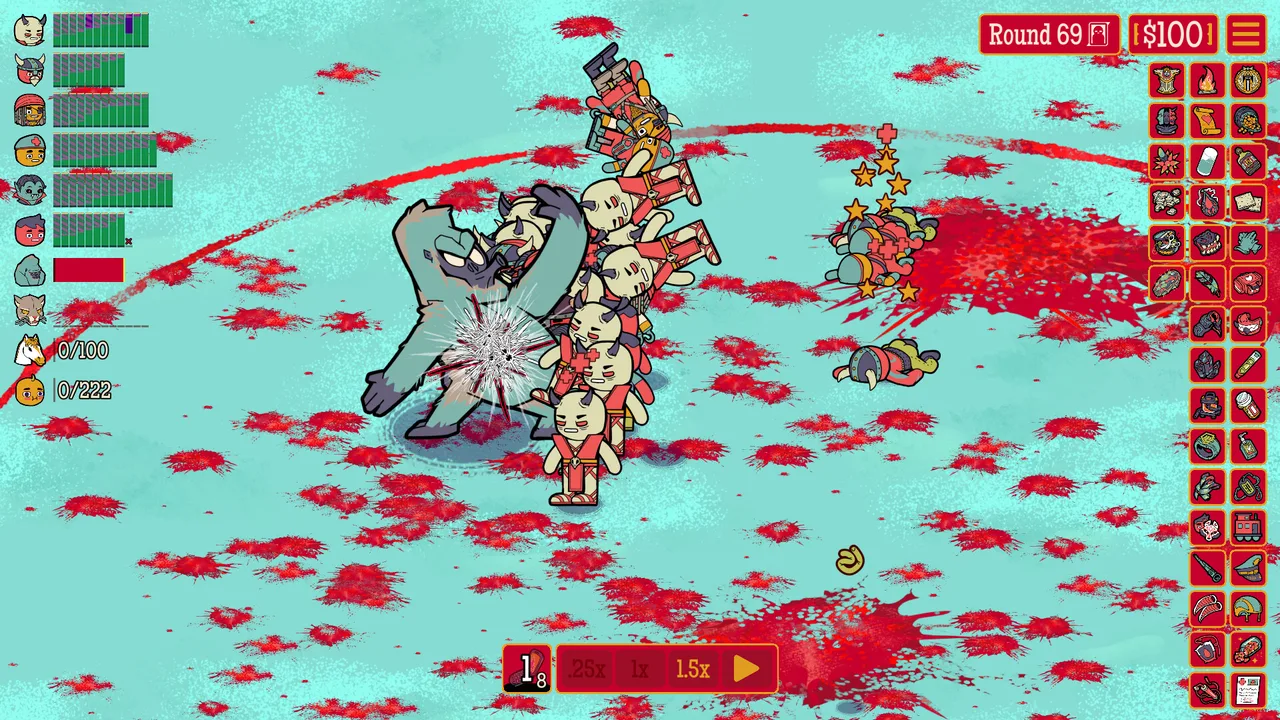 Round 69 of a Tier 1 run. The Relic grid on the right is most of a run's progress made visible. (Screenshot: Butterscotch Shenanigans)
Version note: Written August 5, updated August 16, 2026, against v1.0.12-rc.5. The developers ran a beta experiment on this rule in early August and dropped it on August 5, so the live unlock rule is settled again; every patch since has been bug fixes, with the first balance pass signposted as 1.1. Sourced from their Steam announcements and launch-window player reports, linked inline.
What a Gold Star Is
The star system is per Dude, and it is the spine of the whole progression:
- Defeating bosses earns Silver and Gold Stars for each Dude, per the store page.
- The Tier 1 final boss is the G.O.A.T., and the developers' own guide places it precisely: your first goal is "to get gold stars by defeating the G.O.A.T. in Tier 1 on round 105." 71.1% of players have managed it.
- Tier 2's final boss is the Killipede, at 9.6%. Tier 3's final battle sits at 1.5%.
- Stars also feed metaprogression: starting cash, consumables, Pocket Dice, and Ensemble Mode slots. The developers confirm all five Ensemble slots unlock gradually "as you earn Silver and Gold Stars across the challenge Tiers."
One rule the developers do state clearly, and it is the most useful thing on this page: stars backfill downward. From their official guide:
"Gold and Silver Stars for Relics and Trinkets get retroactively applied to lower Tiers. So if you have just a few Relics or Trinkets left to get Stars for in Tier 1, you can jump up to Tier 2 and earn those Stars there, and it will cascade down and backfill in Tier 1, so you could potentially finish your Tier 1 collection while not even playing in Tier 1."
Note the precise scope: they name Relic and Trinket stars. The August beta announcement puts it more broadly, saying a Tier 3 Gold Star win "would also provide progress toward your T2 and T1 rewards." Either way the practical instruction is the same — if you can win at a higher Tier, earn your stars there.
The Actual Rule
The developers stated it plainly on the Steam forums on July 30, and it is the clearest answer available anywhere:
"To use dudes on Tier 2, you'll need gold stars on them for Tier 1. For Tier 3, you'll need golds for those dudes in Tier 2."
That is the whole mechanic. Gold Stars are earned per Dude, and a Dude only becomes usable one Tier up once it personally has one. It is not an account-wide unlock, which is why clearing Tier 1 with a favourite team does nothing for the other 37 Dudes.
The rule is not in the in-game UI, not in the developers' published new-player guide, and not on the store page — it exists only as a forum reply. That is why player accounts of it vary so much. Three separate launch reviewers describe it as "complete a full run with that Dude," "beat Tier 1 with at least 15 of them on your team," and "you needed 10 items in its category during the run." None of those match the developers' wording. Go with the developers' version.
There is one genuine open question the developers have not resolved: exactly which round threshold gates each Tier. One well-known community regular says clearing round 105 (the G.O.A.T.) opens Tier 2 and round 110 opens Tier 3, but elsewhere describes Tier 3 as unlocking from clearing the Killipede in Tier 2. Those are not the same claim, and no developer statement settles it. Treat the round numbers as unconfirmed; the Gold Star rule above is the part you can rely on.
Why This Is The Game's Sore Spot
The grind complaint is the one the developers have publicly engaged with, so it is worth understanding the shape.
A Tier 1 run runs to round 105 (the developers' figure), which players time at about 30 minutes at the fastest 1.5x speed, and often longer — several players put a full run at 40 to 60 minutes. Multiply that by a roster of 42 Dudes and the arithmetic gets ugly fast. One completionist puts the cost of unlocking everything for Tier 3 at 30 to 35 hours of lower-Tier play. Against a median total playtime of about 10 hours across 1,000 launch reviews, that is a grind most players never finish, and 20% of negative reviews name it directly.
The developers' own framing when they opened the experiment:
"It turns out that for some players, Tier 1 is just too dang easy, and so it feels like a tedious grind to get to the difficulty they'd like."
They also shipped two UI patches about this in the same week — v1.0.5-rc.7 made the Tier indicator visible in Tier 1, and rc.8 added a Tier indicator above the Victory screen "to make it more understandable that there are higher difficulties." Players were finishing the game without realising there was more of it.
The Beta Experiment (Dropped August 5)
For a few days in early August the developers ran a beta branch that changed these unlock rules. It is worth knowing what it was, because it is still the most-searched thing about this topic — and it is over.
Opened August 3, it started fully permissive (pick any difficulty from the start, no gold-starring at all), then was pulled back on August 4 to a middle ground: Tier 2 open from the outset, but still a Gold Star required before a Dude unlocked in Tier 3. On August 5 the developers ended it:
"Based on mixed-to-negative player feedback about this experiment we've decided to not make this change at this time."
So the beta is no longer offering a different unlock rule. The per-Dude Gold Star requirement described above is the live game, and there is no branch you need to switch to. The metaprogression unlocks were never part of the experiment either — those Gold and Silver Stars still gate your starting cash, Ensemble slots, dice and consumables regardless.
The grind complaint that prompted the experiment has not gone away, and the developers have said a free update with quality-of-life changes is coming "within a couple of months" — but no reworked unlock rule has been promised, and they explicitly declined to ship this one.
How to Play Around It Today
With the beta gone, there is one live rule to plan against, and the efficient route follows from the cascade rule and the run length:
- Win at the highest Tier you can actually clear. Stars cascade down, so a higher-Tier win pays for the lower Tiers too. Grinding Tier 1 for stars you could earn in Tier 2 is wasted time.
- Commit a run to the Dudes you want unlocked. Every unverified version of the requirement rewards concentration, and none reward spreading thin.
- Finish the run. Version A specifically claims a loss at the final boss voids the attempt. It is unconfirmed, but the downside of assuming it is true is zero.
- Use Ensemble Mode once you have slots. Pre-picking your team instead of taking random flyers is what turns unlocking specific Dudes from luck into a plan. Empty slots still roll random, so partial unlocks are still useful.
- Don't wait for the beta shortcut — it was dropped. The experiment that would have opened Tier 2 early is gone as of August 5. A free quality-of-life update is promised "within a couple of months," but no reworked unlock rule has been committed, so plan around the current one.
Where the Difficulty Actually Lives
Worth setting expectations against the achievement data, because "Tier 3" sounds like a difficulty setting and behaves like an endgame. Beating a boss at all: 95.8% of players. Tier 1's G.O.A.T.: 71.1%. Tier 2's Killipede: 9.6%. The Tier 3 final battle: 1.5%.
The drop from Tier 1 to Tier 2 is the real wall, and it is much steeper than the Tier 1 experience suggests. If Tier 1 felt like it played itself — a common launch-review complaint, with 26% of negative reviews saying the game is too easy or impossible to lose — Tier 2 is where the game you were promised starts.
The Killipede got its first nerf on August 14. Patch v1.0.12-rc.5 gave it a per-Dude cooldown on how often it can throw Dudes with its lightning shocks — previously it could chain-throw the same Dude out of the fight repeatedly. That is a direct hit on the wall this section describes, so a Tier 2 attempt that stalled there before August 14 is worth retrying rather than rebuilding around.
If Tier 2 Suddenly Feels Harder, It Isn't
A player who had cleared Tier 3 runs reported losing Tier 2 repeatedly with teams that used to win, and asked whether something had changed. Nothing has: every shipped patch so far has been bug fixes, with no balance pass. The first content-and-balance update is signposted as 1.1 with no date.
Read a losing streak as run-to-run variance rather than a stealth nerf. Where the game genuinely changed, it changed in your favour — see the Killipede note above.
The thread has since produced a better explanation than variance, and it points back at the unlock system. One player names the mechanism directly: once you have Gold-Starred your strongest Dudes, you stop playing them. The stars are the goal, so every subsequent run is built from whatever you have not cleared yet — which is, by definition, the weaker or more awkward half of your roster. The difficulty curve you feel is your own roster selection moving, not the game moving.
Two other posters describe the same effect from different directions: one had been chasing a Tier 2 Ensemble unlock and so was deliberately running unfamiliar Dudes, another changed how he spends gold mid-run and started losing while he hunted the new sweet spot. A fourth adds the flat structural point — one bad round loses a run, and plenty of runs fail even at Tier 1.
What to do about it: when a losing streak starts, check what changed on your side before you look for a patch. If you are running Dudes you picked for their stars rather than for the comp, that is the answer, and it is a cost of the unlock system rather than a difficulty change. Alternate star-hunting runs with a comp you already trust, so a bad week does not turn into a wall.